Between the Eagle and the Dragon: The Rise of the Strategic Sunni Quad.
” Is it a new map of the world being drawn and it isn’t being drafted in Washington or Tel Aviv but monitored by Dragon outsmarting Eagle.”
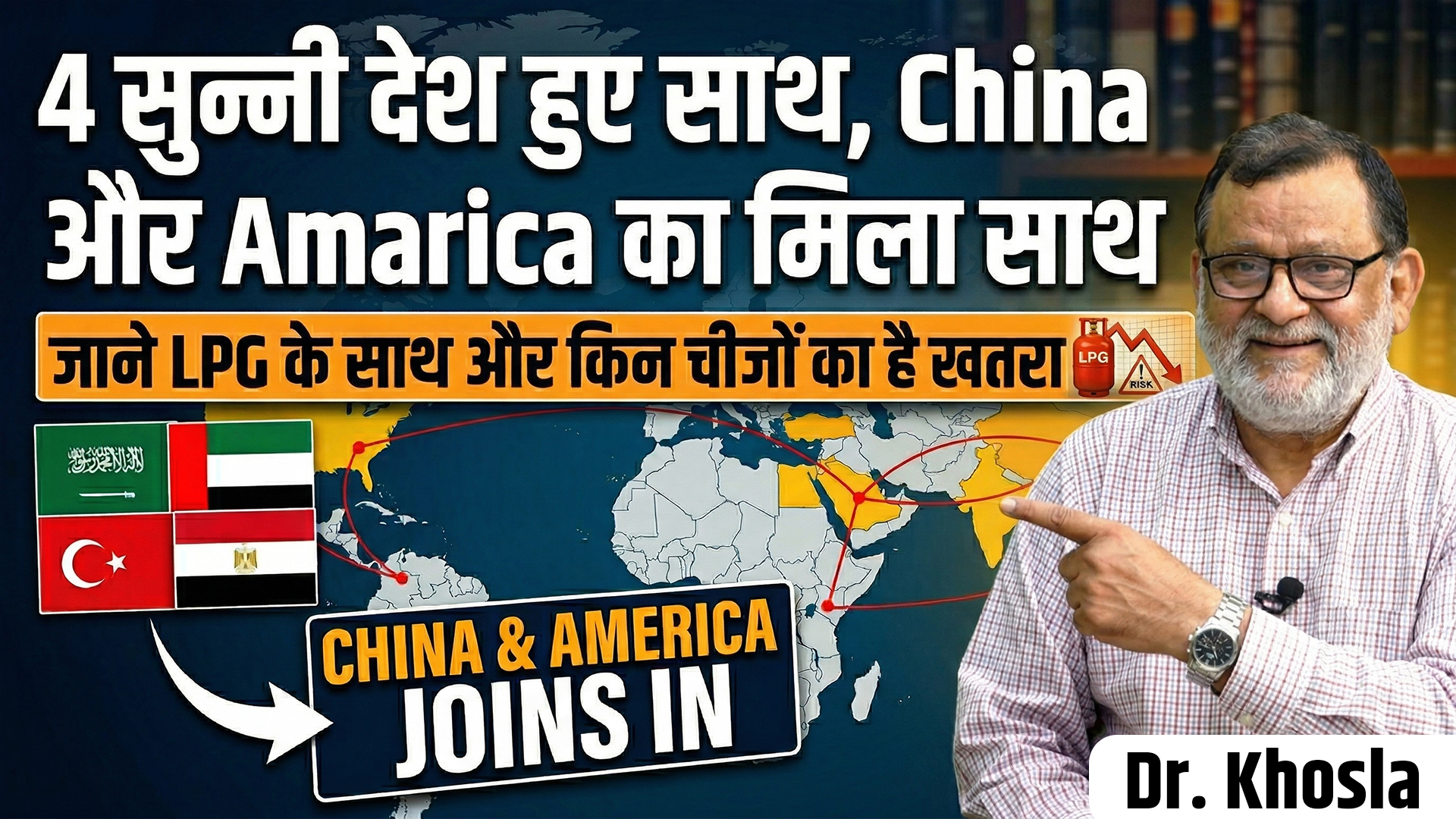
In the marble halls of Islamabad this March the foreign ministers of Turkey, Egypt, Saudi Arabia, and Pakistan gather under a cloud of regional conflict.
Do they represent more than just a religious majority. Do they represent the birth of a ‘Sunni Power Block’ that is weary of Western intervention.
Is it fueled by Chinese hardware and a shared sense of strategic autonomy. Are these four nations no longer content to be the foot soldiers of American foreign policy. Are they positioning themselves as the ultimate mediators, holding the keys to both the world’s energy flows and the region’s fragile peace.”
4 सुन्नी देश हुए साथ, China और Amarica का मिला साथ , जाने LPG के साथ और किन चीजों का है खतरा
Or is it another platform for Eagle and Dragon frenemy conflict resolution.
Sunni Islam is the dominant denomination in Turkey, Egypt, Saudi Arabia, and Pakistan.
On the surface it appears as “Sunni Dominance” factor—opposing Israel’s war and containing Iran’s ambition, but refusing to fight Iran directly.
They don’t want a war with Iran (which would be a disaster for their economies), but they don’t want Iran to become the regional hegemon either.
Saudi Relations have deteriorated with Iran as it faced direct missile and drone attacks and recently expelled Iran’s military attaché. Riyadh maintains a hardline stance, pushing for tough international censure.
Turkey and Iran are historic rivals for regional influence in Syria and Iraq, yet they maintain a strong trade relationship.
Interestingly they all had also received warnings from the US. Turkey recieved Institutional Sanctions under the Countering America’s Adversaries Through Sanctions Act (CAATSA), the U.S. imposed a ban on all export licenses and authorizations to Turkey’s primary defense procurement entity, the Presidency of Defense Industries (SSB).
Egypt has faced intense pressure to cancel deals with America’s rivals, often resulting in “technological dilemmas” for Cairo.
U.S. warnings toward Pakistan are uniquely focused on regional stability and global nuclear security.
The Pentagon’s 2025 and 2026 reports have “sounded the alarm” that China is actively planning to establish a military facility in Pakistan to support its power projection in the Arabian Sea.
The U.S. warns that China is using Pakistan as a “geopolitical tool” to tighten military pressure on regional allies.
While often more private, U.S. warnings to Riyadh center on “untraceable” technology. The U.S. has cautioned Saudi Arabia that building its own ballistic missiles with Chinese assistance undermines regional arms control and complicates U.S. security guarantees.
Pakistan is the primary operator of high-end Chinese hardware, serving as a marketing showcase for Beijing’s defense industry.
As of early 2026, Pakistan has inducted a full fleet of 36 J-10C (J-10CE) multi-role fighters. These are 4.5-gen jets designed specifically to counter India’s French-made Rafales. The Hangor-class submarine program is critical. Pakistan ordered 8 submarines based on China’s Type 039B Yuan-class. As of 2026, the first four are being built in China and the next four are in Karachi, with complete technology transfer.
Pakistan has deployed over 300 VT-4 Main Battle Tanks (MBTs). These are China’s premier export tanks, featuring active protection systems comparable to Western models.
Pakistan produces the Wing Loong II armed drone domestically (under the name “Burraq” variants or similar licensed production), giving it cheap, expendable air support.
In a landmark 2025–2026 deal,
Saudi Arabia had signed a $5 billion agreement to establish a manufacturing plant for Wing Loong-3 drones in Jeddah. This facility is set to produce up to 48 advanced combat drones per year.
Unlike U.S. sales, which come with strict “end-use” restrictions like ” not for use in Yemen”, Chinese sales come with zero political strings attached
In this scenario, China is not just watching from the sidelines; it is actively bankrolling and politically backing this “Sunni Power Block.” Beijing views this alliance as the perfect “Geopolitical Safety Valve”—a way to protect its economic interests (Belt and Road Initiative) without having to deploy the Chinese military to the Middle East.
China’s interest through three strategic “Shields” .This alliance provides The Energy Shield (Saudi Arabia & Egypt): China imports massive amounts of oil from the Gulf. The U.S.-Iran war threatens the Strait of Hormuz. This Sunni Bloc controls the Red Sea (Egypt) and influences the Gulf (Saudi). China needs them to keep the oil tankers moving, even if the U.S. Navy is busy fighting.
For China the Security Shield is Pakistan. The “Ironclad” Bridge: China is terrified of the conflict spilling over into South Asia. It views Pakistan as a “firewall.”
Reports suggest China is encouraging the Pakistani military to provide security guarantees to the Gulf states. This allows China to protect its investments in Saudi Arabia without putting PLA soldiers on the ground.
The Political Shield for China is Turkey as it is a NATO member. When Turkey coordinates with China, it creates a crack in the Western alliance.
China uses its ties with Turkey to show the world that even U.S. allies prefer Beijing’s “development-first” approach over Washington’s “security-first” approach.
While the U.S. is engaged in kinetic military action (the war with Iran), China is positioning itself as the “adult in the room.”
The Public Stance of China is of support. Beijing has officially “lauded” the mediation efforts of Pakistan, Saudi Arabia, and Turkey. The Chinese Foreign Ministry is using this summit to push a narrative that “Regional problems require regional solutions” a direct critique of U.S. interventionism.
Diplomatic Support by China is using its UN Security Council seat to shield this bloc from Western pressure, arguing that their “neutrality” is essential for global energy stability. China’s strategy to “win without fighting is rooted in Sun Tzu’s philosophy.
Is it an upmanship of Dragon over Eagle or Eagles strategy to prepare a platform against Iran and countering Sun Tzu philosophy.
Prof (Dr.)Prem Prakash4 सुन्नी देश हुए साथ, China और Amarica का मिला साथ , जाने LPG के साथ और किन चीजों का है खतरा
